
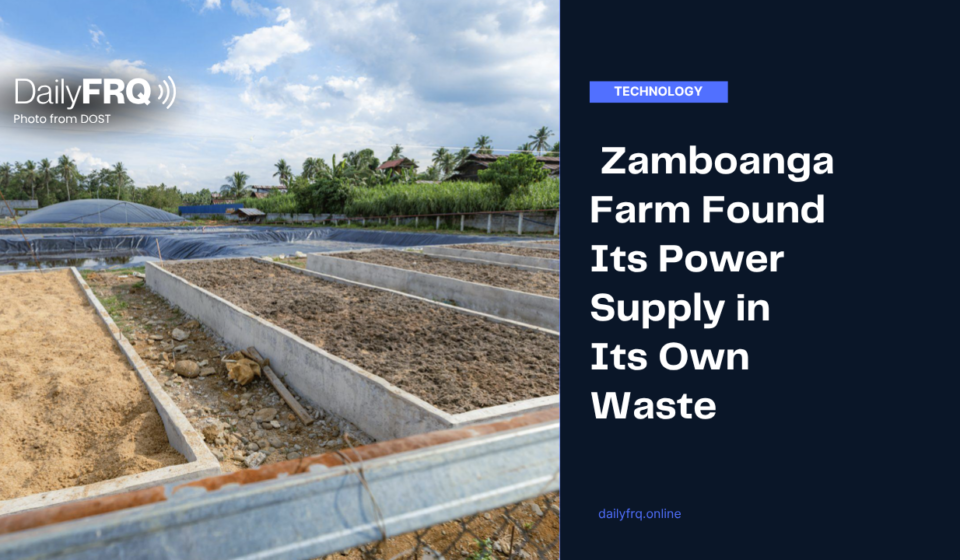
Zamboanga Farm Found Its Power Supply in Its Own Waste
Rockefeller Farm raises more than 100,000 chickens and pigs on seven hectares in Zamboanga del Norte. That much livestock produces a lot of waste. For years, it also meant flies swarming the property and neighbors calling in to complain about the smell.
Farm owners Lester and Haidee Ong solved it by building a biogas digester on their own land. The Department of Science and Technology backed the P5 million facility through a zero interest loan under its Small Enterprise Technology Upgrading Program. The digester is an airtight chamber that breaks down animal waste and captures the methane gas it releases.
The Pit That Runs on Bacteria
The structure goes down three stories, about the same depth as a three story building. Lester said it’s designed to process the manure of up to 50,000 chickens. Waste from the farm’s poultry and pig housing collects there, where microorganisms break it apart and release gas. That gas rises into a dome shaped digester, part of a waste management system that also includes four lagoons.
A biogas generator burns the gas as it travels through pipes and converts it into electricity. The generator runs at 300 kilovolt ampere capacity and can operate continuously for 24 hours, though the Ongs choose not to push it that far to avoid wearing out the machine.
The material left over from the process becomes fertilizer. It retains nitrogen, phosphorus, and potassium, and some of the farm’s employees use it for their own vegetables.
What the Switch Actually Saves
Without the digester, Lester said, “our electricity bill would run up to P800,000 to P900,000.” Today, running the machines costs the couple somewhere between P40,000 and P50,000 a month. Daily Tribune separately reported the facility has helped the farm save nearly P1 million in electricity costs overall.
The Ongs are looking into a backup generator, using DOST’s newer partnership with Land Bank of the Philippines, which lets micro, small, and medium enterprises apply for loans of up to P50 million.
Where the Farm Actually Is
Sourcing on this gets slightly inconsistent. Daily Tribune places the facility in Barangay Labrador, Polanco, Zamboanga del Norte. Manila Times and Philstar both describe it as based in Dipolog City. Polanco sits just outside Dipolog, and the farm’s products move through Dipolog’s restaurant and distribution network, which may explain why coverage splits on the exact location.
A Business Built to Grow
Rockefeller Farm already supplies restaurants in Dipolog City and works with distributors carrying major consumer brands. Its products reach other parts of the Zamboanga Peninsula, as well as Dumaguete City and Cebu. With a major operating cost cut down, the Ongs say they’re planning to expand production further.
DOST officials, including Undersecretary for Regional Operations Sancho Mabborang and Zamboanga Peninsula Regional Director Rosemarie Salazar, toured the facility on August 11, during the 2026 Zamboanga Peninsula Regional Science and Technology Week held in Dipolog City. Lester has also floated a bigger idea: applying the same technology to landfills, which he believes could power five to 10 barangays given the volume of gas they produce.