
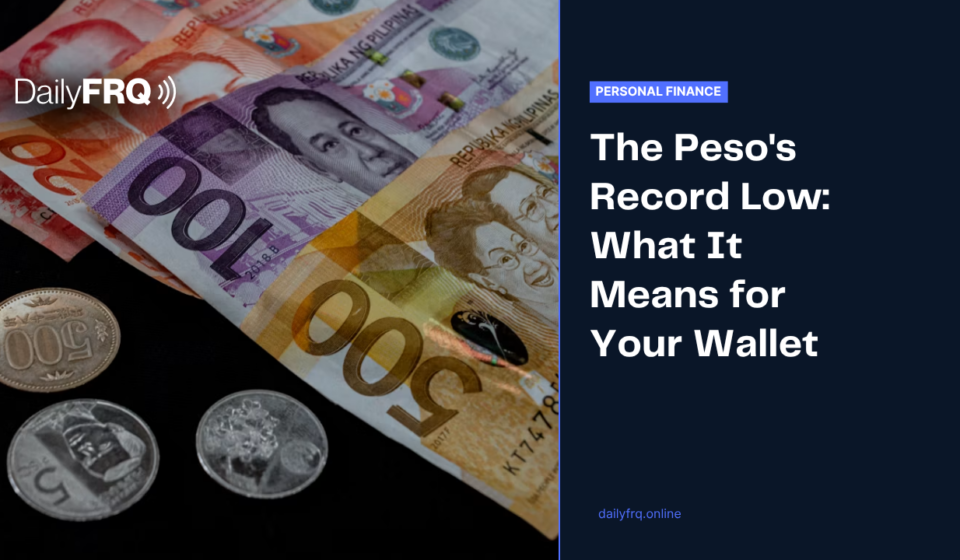
The Peso’s Record Low: What It Means for Your Wallet
The Philippine peso closed at P62.59 against the US dollar on Friday, its fifth straight session at a new all-time low. The currency opened at P62.43 and hit P62.65 intraday before pulling back. That seven-centavo drop from Thursday’s P62.52 finish extended a slide that has been going since late August.
Why the Peso Keeps Falling
Three things are driving it: a stronger US dollar, rising global oil prices from the Middle East conflict, and a trade deficit that leaves the Philippines with limited cover against both.
The dollar got stronger as US Treasury yields climbed and markets priced in further Federal Reserve action. Oil prices rose as geopolitical tensions escalated. For a country that imports most of its energy, those two pressures together are a direct hit. Every sustained 10% depreciation of the local currency adds roughly 0.3 to 0.5 percentage points to headline inflation through higher import and transport costs, according to analysts cited by BusinessWorld.
The BSP’s Position
BSP Governor Eli Remolona said the central bank is monitoring the foreign exchange market. “What we do is to manage the sharp movements in the exchange rate,” Remolona said.
He also said there is a ceiling on what that can accomplish. The Philippines runs a trade deficit and its export base is not strong enough to generate sustained dollar demand. “It is difficult to stop the peso’s fall. The BSP can slow the peso’s depreciation, but it cannot fix the exchange rate. We will run out of reserves,” Remolona said.
The country’s gross international reserves dropped to $103.317 billion as of July, an 18-month low. That limits how aggressively the BSP can intervene before burning through its buffer.
What Analysts Are Watching
PIDS senior fellow John Paolo Rivera said the odds of the peso testing P63 have risen, especially if oil prices, geopolitical tensions, and dollar strength stay elevated.
Regina Capital’s Luis Limlingan said the P63 level is a major psychological threshold where the BSP may step in. “While the initial drop past P62.50 reflects a knee-jerk shift into safe-haven US dollar assets triggered by geopolitical tensions, persistent pressure could linger as long as elevated global crude prices and high US yields remain,” Limlingan said.
On the other side: year-end remittances and seasonal dollar inflows typically provide some relief to the peso in the fourth quarter.
Slower Inflation, No Peso Relief
August inflation came in at 6.1%, down from 6.2% in July. It was the fourth straight month of slower consumer price growth. The stock market took that as a mild positive and edged up. The peso did not move with it.
The BSP had already raised rates by 25 basis points to 5% the week prior. Analysts said the peso remained vulnerable to elevated US Treasury yields, a strong dollar, higher commodity prices, and ongoing geopolitical uncertainty regardless of the rate move.
Malacañang said it will step up measures to protect vulnerable sectors from rising costs as the peso’s continued drop is expected to push living costs higher.
P63 is not a given. But it is the number everyone is watching right now.