
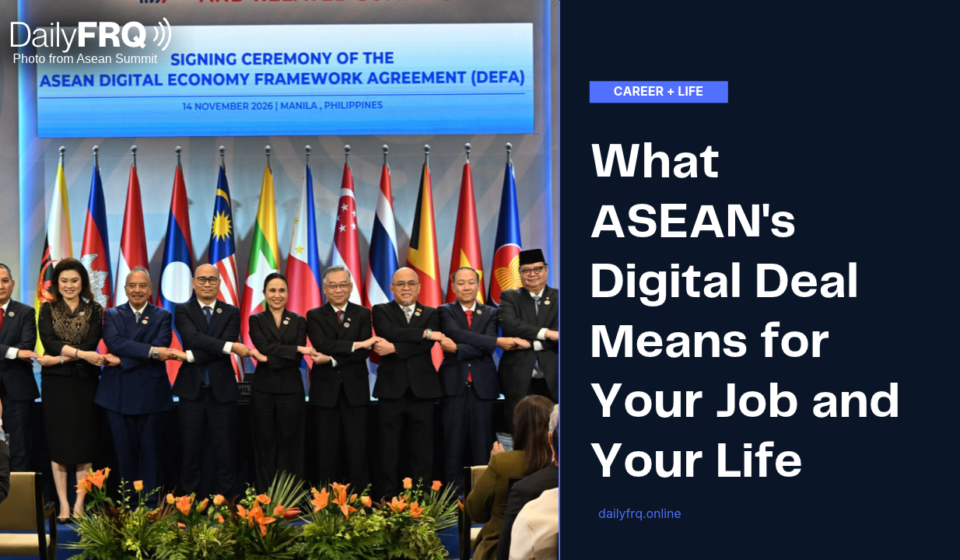

Southeast Asian leaders are in Manila this week. The 49th ASEAN Summit runs from Nov 15 to 17, with the Philippines hosting as the 2026 chair.
Most coverage will focus on diplomacy. This piece is about something closer to home: how Filipinos work and earn.
The deal in plain terms
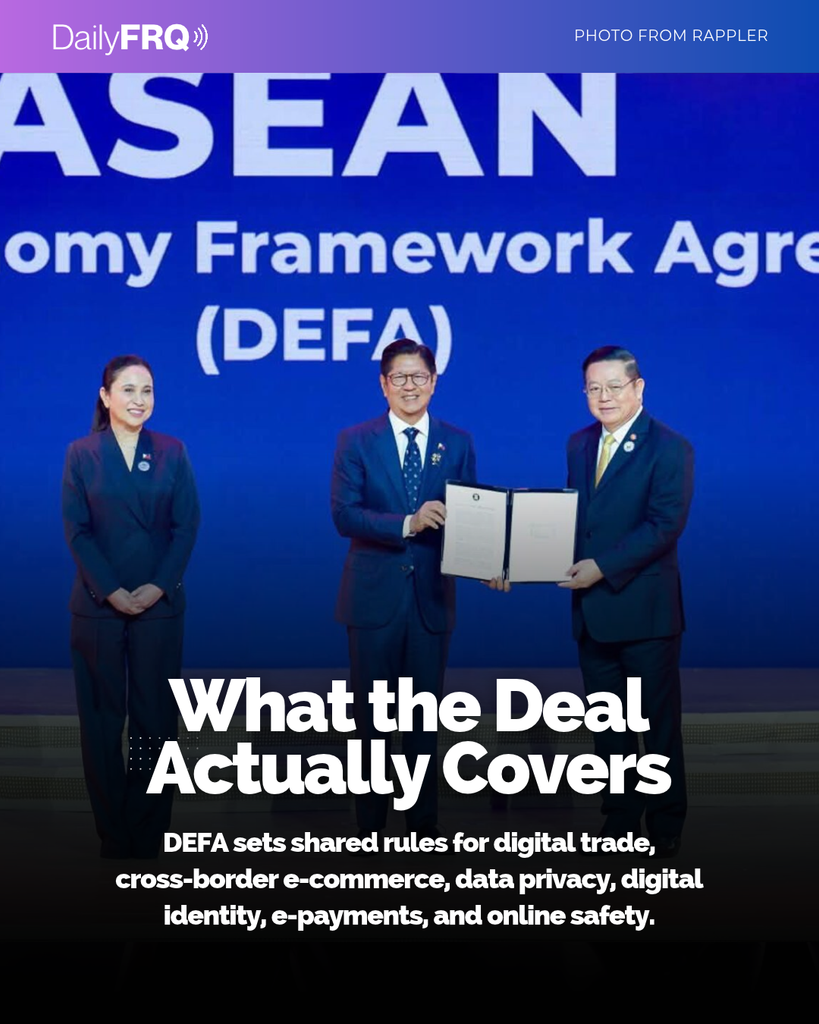
ASEAN member states have finished negotiating the ASEAN Digital Economy Framework Agreement, or DEFA. Negotiators resolved the last open issues in Manila on May 29. Officials now expect it to be signed at this summit. It is described as the world’s first binding region-wide deal on the digital economy.
DEFA covers digital trade, cross-border e-commerce, data governance and privacy, digital identity, electronic payments, and online safety. In short, it sets shared rules for doing business online across borders.
The scale is large. Studies cited by ASEAN officials say successful implementation could lift the region’s digital economy to as much as USD 2 trillion by 2030. The Philippine Chamber of Commerce and Industry says the region is already on course for around $1 trillion by that year.

The base Filipino jobs already stand on
The Philippine digital economy reached P2.74 trillion in 2025. That is 9.8 percent of GDP. It supports more than 10 million jobs, and one in every five workers has a stake in it.
That is the foundation DEFA would build on.

What it could mean for your career
The Department of Trade and Industry says DEFA is set to bring real benefits to everyday Filipinos. GovInsider reports that the agreement is meant to open doors for investment, jobs, and new businesses across the region.
Freelancers are part of this picture. A Philstar column notes that a great portion of the creative industries is the gig economy, made up of freelancers outside formal setups or small outfits working per project. Payments, identity, and data are the systems online work runs on, and those are the areas DEFA covers.
Skills are the other half. Herminio Bagro, the Philippines chief representative of the US-ASEAN Business Council, says DEFA commitments need to become interoperable rules, stronger digital infrastructure, and workforce development that matches industry demand. His stated goal is growth that turns into quality jobs.
Investment is already moving. The Board of Investments reports that ASEAN investments from January to July 2025 reached P58.07 billion and were projected to create over 15,000 jobs. The BOI ties those investments to smart manufacturing, renewable energy, and the digital economy.
Small businesses carry the load
Go Negosyo founder Joey Concepcion says micro, small, and medium enterprises generate more than half of the country’s jobs. He says part of the goal this year is to bring ASEAN closer to ordinary Filipinos through large-scale job fairs and mentoring programs held alongside summit activities.
The chairship also scheduled the ASEAN MSME Summit and the ASEAN Creative Industries Expo by Malikhaing Pinoy for Sept 17 to 21.
The fine print
The numbers describe an opportunity, not a guarantee. The $2 trillion projection depends on successful implementation. ASEAN economic ministers said the full benefits of DEFA depend on timely signing, effective implementation, and sustained cooperation among member states and stakeholders.
The Philippine Chamber of Commerce and Industry says the agreement “opens doors.” It adds that firms and workers still need help to walk through them.
A study by the Philippine Institute for Development Studies found that the country’s integration into the ASEAN Economic Community has delivered gains, but unevenly, with persistent gaps that could limit broader benefits for Filipinos.
Life beyond the laptop
Energy and food prices sit on the same agenda. The Philippines declared a national energy emergency in March. As chair, it put energy security, food security, and the safety of ASEAN nationals abroad at the top of the list. In May, leaders voiced concern over ASEAN citizens living and working in the Middle East.
Leaders also pledged stronger cooperation against cybercrime and online scams. ASEAN ministers adopted the Manila Declaration on disaster resilience on Sept 16, and leaders are expected to note it at this summit.
A country leading the room
The Philippines plans to use the summit to show it can lead and shape regional priorities while attracting new investments and partnerships.
The year already has a record. In May, leaders amended the ASEAN Charter to admit Timor-Leste as a full member, the first such amendment since 2007. As chair, the Philippines also arranged a meeting between Thailand and Cambodia. Finalizing a South China Sea code of conduct remains a key remaining priority.
After the signing, the work shifts to implementation. ASEAN ministers say that is where the full benefits are decided.