
Terry and Neuralink’s VOICE Trial
Terry has bulbar-onset ALS, a form of ALS that affects speech first while leaving the rest of the body, and the mind behind it, mostly intact. His speech had gotten hard enough for his own family to follow that he joined Neuralink’s VOICE trial. VOICE uses a brain implant to read the brain activity behind intended speech and turn it into spoken words.
How the Implant Turns His Thoughts Into Speech
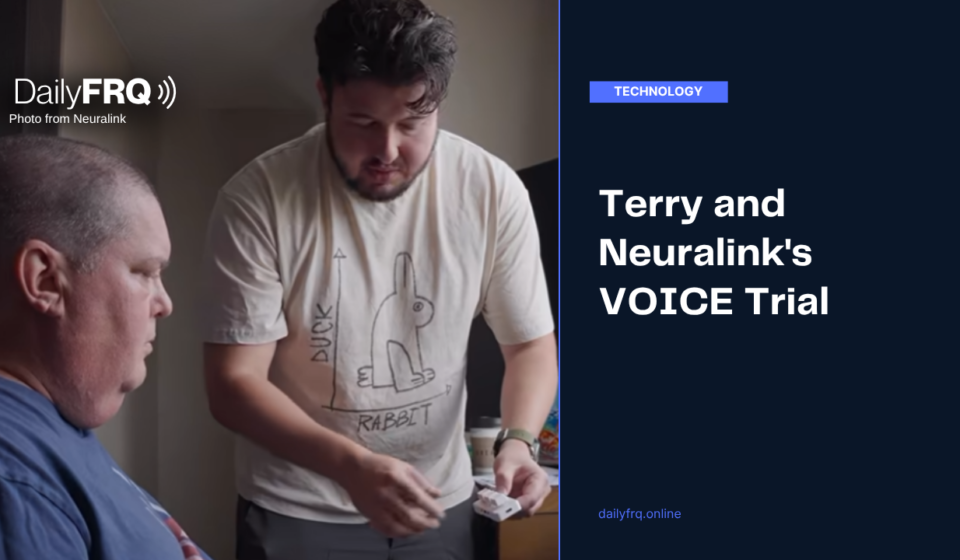
On September 18, Neuralink shared new footage of Terry training the system. He started by miming the words, moving his mouth without making a sound. Once the system learned enough from that, he skipped the miming and just thought the words. The implant read those signals and turned them into audible speech, using xAI’s Grok Voice engine to generate what is reported to be Terry’s own voice.
ABC News reported that this let Terry tell his wife “I love you.” ABC identified him as the third participant in the VOICE trial specifically, not the third person to receive a Neuralink implant overall.
How VOICE Fits Into Neuralink’s Other Work
Neuralink runs more than one trial on the same N1 implant hardware. Telepathy, the company’s original program, lets people control a cursor or device with their thoughts; its first participant, Noland Arbaugh, was implanted in January 2024. VOICE is newer and built for speech specifically. A federal clinical trial registry lists its start date as October 2025.
What Neuralink Hasn’t Said Yet
Neuralink has not published Terry’s implant date, his vocabulary size, latency figures, or how many VOICE participants are currently active. The system is still investigational. It has not been cleared as a consumer product, and Neuralink has not released peer-reviewed data on this specific demonstration.
What’s public right now is a demo video, not a published study. Still, for a man whose family struggles to understand him, saying one full sentence again is real progress.