
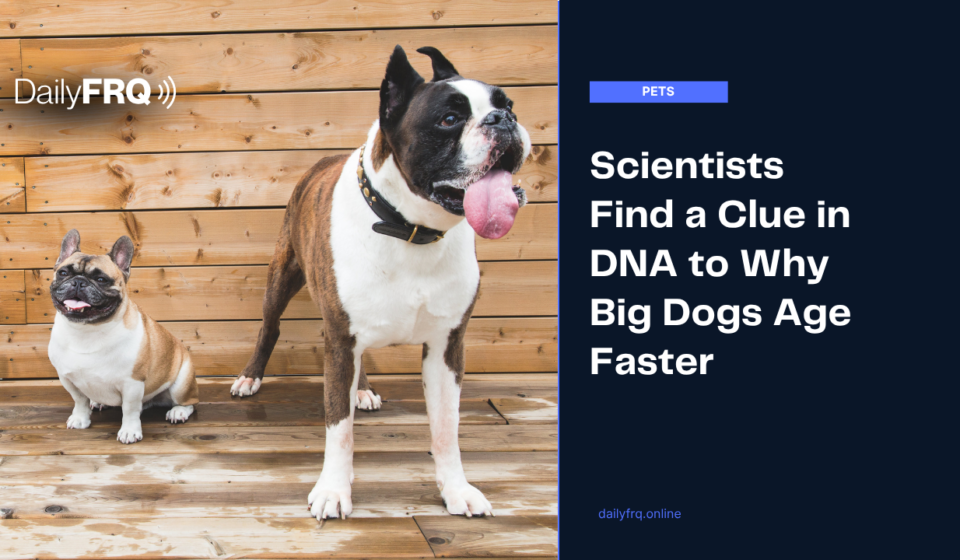
Scientists Find a Clue in DNA to Why Big Dogs Age Faster
Great Danes and mastiffs rarely live more than ten years. Chihuahuas can live twice as long. It has been unclear whether big dogs’ cells actually age faster or whether they simply run into disease earlier. A study published October 8, 2026 in Science points toward the first answer.
894 dogs and a DNA clock
A team at Arizona State University and collaborating institutions analyzed 1,640 blood methylation profiles from 894 pet dogs of various breeds. Methylation is a set of chemical tags on DNA that help control which genes are switched on and off.
Those tags change with age in a predictable way, so the team used them to build an epigenetic clock. It estimated a dog’s age with a median error of under a year (about ten months). Dogs whose biological age read older than expected faced a higher risk of death.
Where big dogs differ
Larger dogs showed signs of accelerated molecular aging. The effect was strongest in parts of the genome that normally keep jumping genes quiet. Jumping genes, also called transposable elements, can copy themselves and insert into new spots in the genome.
One type, LINE1, is normally silenced by methylation. When it wakes up, it has been linked to genome instability, cancer and other age-related disease. In larger dogs, jumping-gene regions lost 31% more methylation with age than in smaller dogs. For LINE1 specifically, giant breeds lost about 35% more per year than small breeds.
Snyder-Mackler, a professor at Arizona State and one of the study’s authors, compares it to the genome losing some of the clamps that hold those mobile elements down.
A separate signal in males
Male dogs also showed differences, largely on the X chromosome. The male effect held even for dogs neutered young. Snyder-Mackler says the sex signal looked distinct from the size signal, so he treats it as a separate biology that needs follow-up.
The price of size
People bred dogs to grow fast and reach large adult sizes for guarding, hunting and herding. Snyder-Mackler says that when selection favors rapid growth or large adult size, late-life costs can come along with it. He also suggests big bodies may trade off fast growth against investment in the immune system and upkeep. That part remains a hypothesis.
Earlier explanations pointed to more cell growth, quicker development and a higher cancer risk. The study does not replace them. Snyder-Mackler describes it as a molecular layer downstream of body size. The team does not know yet whether the methylation changes cause aging or make jumping genes more active.
What this could open up
If parts of the aging program run faster throughout adulthood, then there may be processes that can be measured, followed over time and possibly changed before disease appears. The findings raise the possibility that slowing molecular aging could extend healthy lifespan in larger dogs.
Snyder-Mackler is clear about the limits. Lifespan is not governed by one clock, and large dogs would still carry breed-specific risks. A Great Dane would not become a Chihuahua. One part of its aging could become less compressed.
The team wants to build more informative clocks and predictive models that could help owners anticipate age-related health concerns. No test or treatment comes out of this study yet. Dogs share our homes and environments, so findings about environmental exposures in dogs are expected to translate to people living in the same conditions. Owners who track what their dogs eat and how they live are part of why that research is possible.