
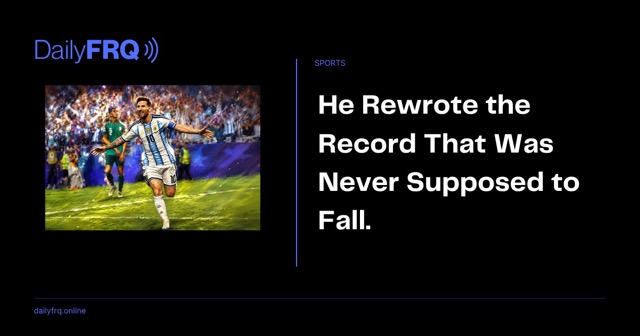
He Rewrote the Record That Was Never Supposed to Fall
Lionel Messi had already won the World Cup. He had the Ballon d’Or eight times over. He had done things on a football pitch that had no clean explanation. And then on June 22, 2026, in Dallas, Texas, he did something nobody had done before.
He became the all-time leading goalscorer in FIFA World Cup history.
What Happened in Dallas
Argentina faced Austria in their second group match of the 2026 World Cup. Messi came in with 16 goals, level with Germany’s Miroslav Klose, whose record had stood for twelve years.
He had a penalty in the ninth minute to break it. He missed.
Twenty-nine minutes later, Thiago Almada pulled off a clever dummy run. The ball landed on Messi’s left foot just outside the box. He swept it into the bottom-left corner. Goal 17. Record broken.
Then, in second-half stoppage time, he scored the rebound off his own blocked shot to put the match out of reach. Goal 18. Argentina won 2-0.
The Numbers Behind the Name
Six FIFA World Cups. 28 appearances. 18 goals. The record covers tournaments from 2006 to 2026, across four continents and two decades.
His first goal came at 18 years old in Germany, as a substitute against Serbia and Montenegro. He is now 38, turning 39 two days after the Austria match. His 18th goal came just as the clock ran out.
He also became the first men’s player to appear in six editions of the tournament. His 18 goals put him ahead of Marta, the Brazilian women’s football legend who held the overall FIFA World Cup scoring record at 17.
He leads the 2026 Golden Boot race with five goals in two matches. All five of Argentina’s tournament goals have come from him.
Twelve Years, One Record
Klose set the previous record of 16 goals in 2014. Messi had been chasing it for years across four more tournaments. He finally tied it with a hat trick against Algeria in Argentina’s opening match of 2026. Then he broke it on a Monday afternoon in Texas, in front of a full house at Dallas Stadium.
“There were moments when I was really angry about missing the penalty,” Messi said after the match. “But I was able to make up for it.”
Argentina have now won eight consecutive World Cup matches since losing to Saudi Arabia in the group stage of Qatar 2022. They are through to the round of 32.
What It Takes to Still Be Here
Messi has scored 12 of his 18 World Cup goals since turning 35. He plays for Inter Miami in MLS. He is two days away from his 39th birthday. His father is unwell back home.
The record did not arrive in his peak years. It arrived at the end of them, in a tournament he almost did not commit to playing.
Some things only get finished by staying with them long enough.