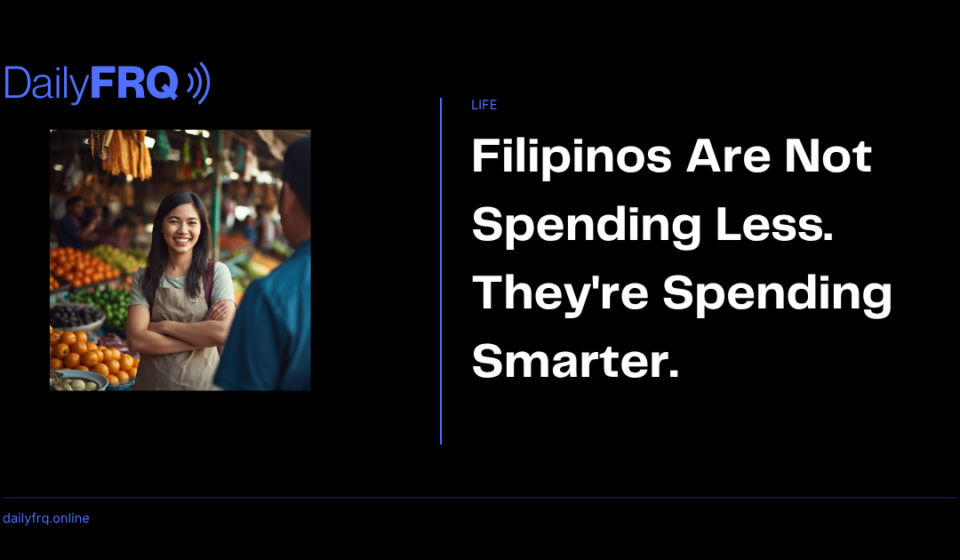
Filipinos Are Not Spending Less. They’re Spending Smarter.
The way Filipinos spend money is changing. Not because they stopped wanting things. Because they started asking harder questions about what those things are worth.
Research from NielsenIQ, Worldpanel by Numerator, and consumer sentiment forums in 2026 all point to the same behavior: Filipino households are making more deliberate choices. They are delaying purchases, switching brands, and tightening the list of things that make it into the cart. But they are not cutting everything equally.
This is the profile of a budget editor, not a budget cutter.
The Mood Right Now
Consumer confidence in the Philippines turned negative in the fourth quarter of 2025. The concerns were specific: corruption, inflation, and the feeling that household income was not keeping pace.
GDP growth slowed to 4.4 percent in 2025, driven in part by a pullback in government capital formation and weaker government consumption. Philippine inflation eased to 1.7 percent that same year, the lowest since 2022. But lower inflation does not mean lower prices. It means prices are rising more slowly. Essentials remain expensive. The relief is not yet felt at the household level.
Into 2026, consumer spending on fast-moving consumer goods is projected to grow at three to four percent, the slowest forecast in recent memory. Year-on-year FMCG growth typically runs between five and six percent.
What the Split-Wallet Looks Like
The shift is not uniform across categories. Filipinos are making finer cuts.
Common behaviors documented this year include buying smaller packs or buying in bulk on payday, switching brands or channels when a better deal is available, waiting for promotions before buying non-essentials, and pulling back on big-ticket items while holding the line on certain everyday spending.
What stays? The things that feel worth it.
NielsenIQ describes this as a “split-wallet” dynamic, where consumers allocate spending across multiple brands and channels based on what delivers the highest return relative to cost. The concept of value is shifting away from the lowest price toward what researchers call emotional return on investment: the satisfaction or relief that a purchase actually delivers.
This creates a tension that researchers identified at the Market(In)Sights 2026 forum in Manila. Consumers are managing tight budgets while still carving out room for small rewards. A budget editor is not someone who refuses to spend. They are someone who decides, deliberately, what earns a yes.
Where the Opportunity Actually Is
The Worldpanel by Numerator FMCG Outlook for 2026 identifies several spending segments that remain active despite the broader slowdown.
Households with at least one overseas Filipino worker spend 25 percent more on average than those without. They tend to buy in larger formats and across more categories. Brands that understand this household structure have a clearer path into those baskets.
Older Filipino shoppers, those 55 and above, spend roughly 10 percent more on average than younger buyers, despite making up only 16 percent of the population. Their share is projected to grow to 34 percent of the population by 2055. Health and wellness products, including plant-based alternatives, are flagged as a growth area for this segment.
Households with pets, which account for 67 percent of Filipino households or roughly 20 million homes, represent another active spending segment. Pet ownership correlates with higher household spending overall, and adjacent categories like pet-safe cleaning products are areas where brands can expand.
The beauty industry also remains active, with consumers spending over 2,000 pesos on average in that category.
The Channel Shift
Where Filipinos shop is also changing.
Hard discount stores like Dali and O!Save are expected to see 77 percent growth in spending capture this year. E-commerce platforms are projected to grow at 15 percent. Traditional channels, supermarkets, hypermarkets, and market stalls, are still growing but losing relative ground.
The growth of discount retail is not a sign that Filipinos are only chasing the cheapest option. It reflects a preference for format, convenience, and the feeling of getting a clear deal. Those are different things.
At the same time, trust is becoming a deciding factor in where people spend. Research presented at Market(In)Sights 2026 described trust as something that is now constantly evaluated rather than assumed. In a split-wallet market, a brand that loses trust is easily replaced. The basket has limited space, and every item in it was decided on.
What This Means for How You Buy
This behavior is not only something companies need to adapt to. It is worth understanding as a framework for your own spending.
The Filipino consumer shift in 2026 is essentially a move toward intentionality. Spend on what genuinely delivers. Hold back on what does not. Accept that a small joy is still a valid purchase, as long as it actually brings joy.
Budget editing is not the same as being broke. It is a skill. And Filipinos appear to be getting better at it.