
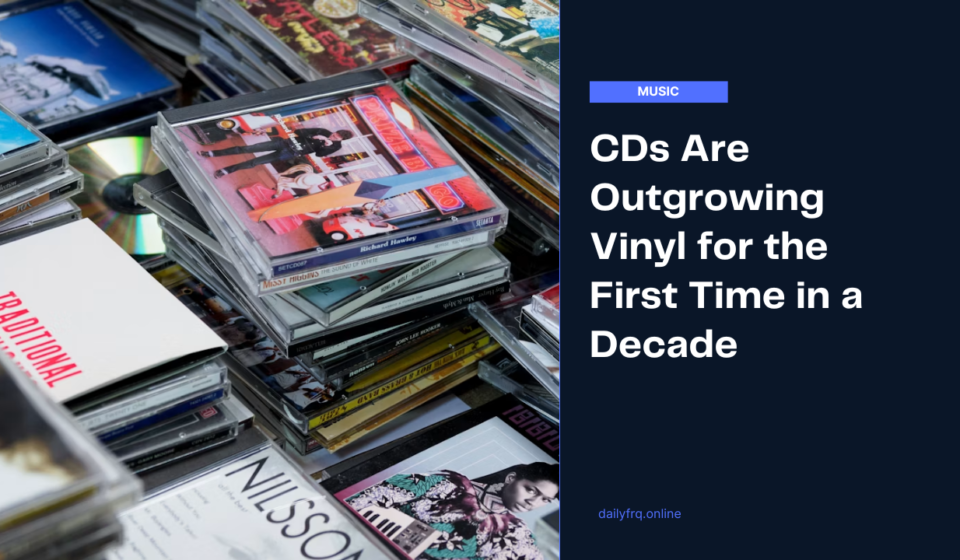
CDs Are Outgrowing Vinyl for the First Time in a Decade
For the first time in more than a decade, CD sales are growing faster than vinyl in the United States.
During the first half of 2026, CD sales rose 16%, reaching 16.3 million units. Vinyl sales increased too, but at a much slower rate of 2.4%. Across CDs, vinyl records, and cassettes, Americans purchased 38.2 million physical music units—a 7.8% increase from the same period last year.theverge+1
The surprising part is not that people are buying physical music again. That trend has been building for years.
The surprising part is that the format many people considered finished is now growing faster than the format that led the physical-media revival.
Vinyl slowed, but did not disappear
Vinyl is still the larger format, and its growth has not ended. It has simply begun to mature.
The early stages of the vinyl revival were powered by novelty, nostalgia, record-store culture, and the appeal of owning an album in a large, physical form. But as the market expands, rapid growth becomes harder to maintain.
CDs are entering the conversation from a different position. They are smaller, cheaper to produce, easier to ship, and often more affordable for fans. They also leave more room for deluxe packaging, bonus content, photo books, and collectible editions.
The competition is not necessarily between vinyl and CDs.
Both formats are offering something streaming does not: a physical relationship with the music.
K-pop helped, but did not explain everything
K-pop played a major role in the numbers.
BTS released five CD versions of ARIRANG in March, generating roughly 567,000 U.S. CD sales during the first half of the year. That is a significant contribution to the overall market, especially when physical albums function as both music releases and collectible objects.theverge+1
But the CD comeback is not riding on one group.
Even after removing ARIRANG from the data, CD sales still grew by 6.7%. That suggests the wider market is moving—not simply reacting to a single superstar release.
K-pop has helped redefine what buying an album can mean. The purchase may include multiple versions, exclusive artwork, photo cards, posters, or packaging designed to be displayed and collected.
The CD is no longer only a disc.
It is part of the experience around the release.
The shelves doing the selling
Another important detail is where these albums are being sold.
Mass-market retailers such as Target and Walmart accounted for nearly 30% of physical album sales. That matters because the current physical-music audience does not always have to visit an independent record store to buy an album. The purchase can happen during an ordinary shopping trip. digital music news
Retailers have also learned how to make physical editions feel special. Exclusive versions and deluxe packaging give shoppers a reason to choose ownership over access.
Streaming provides nearly unlimited access to music. A physical album provides a specific object connected to an artist, a moment, or a memory.
That distinction is becoming more valuable.
Cassettes require more than nostalgia
The cassette revival follows a similar logic, but it also reveals a practical problem: nostalgia alone cannot manufacture tape.
National Audio Company, based in Springfield, Missouri, now produces its own magnetic tape after developing and manufacturing tape formulations in-house. The company says it has expanded its capabilities to make tape at its own facility, rather than relying entirely on older sources. national audio company
A partnership with Revox is also bringing a National Audio cassette production line to Villingen, Germany, supporting the production of both blank and prerecorded cassettes.revox
That investment suggests the cassette revival is not just a temporary aesthetic trend. There are companies building the infrastructure needed to keep the format available.
Still, the cassette market remains much smaller than CD or vinyl. Its future depends on whether enough listeners want the format, and whether manufacturers can continue producing it consistently.
What is actually growing?
Streaming still dominates listening. In the first half of 2026, U.S. on-demand song streams reached roughly 733 billion, up 4.8% year over year. Physical music is growing, but it is growing alongside streaming rather than replacing it. digital music news
That may be the most important part of the story.
People are not abandoning convenience. They are deciding that some music deserves to be owned.
The album they played during an important year. The release connected to a favorite artist. The record they found in a shop. The CD with artwork they want to keep. The cassette that feels like a personal artifact instead of another file in a library.
Streaming is about access.
Physical music is about attachment.
The format may change: vinyl, CD, or cassette, but the impulse is the same: to hold on to something.
What was the last album you actually paid for and kept?