
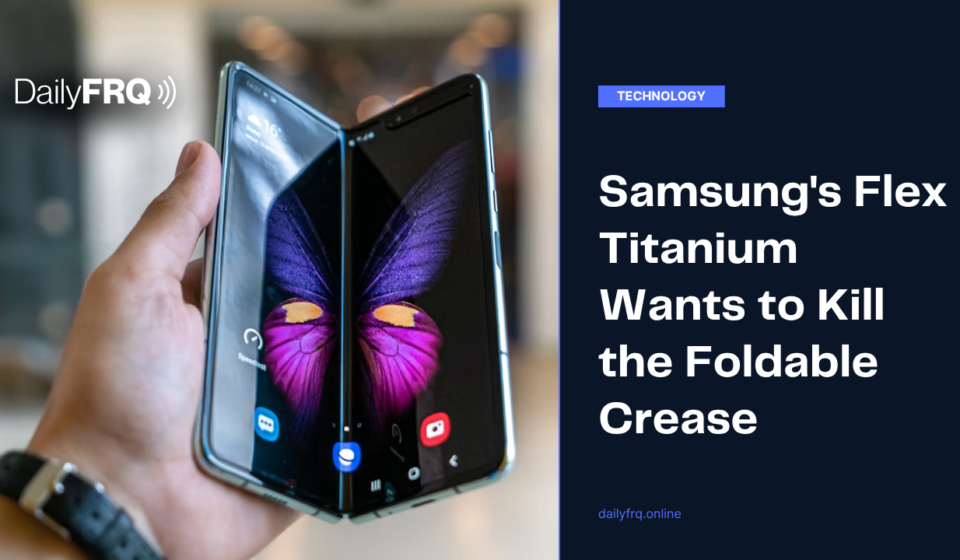
Samsung’s Flex Titanium Wants to Kill the Foldable Crease
Samsung has a new answer to the one thing every foldable owner complains about. The crease down the middle of the screen.
The company unveiled Flex Titanium on July 15, a redesigned display structure built on seven generations of Galaxy foldable engineering. It swaps out the polymer film traditionally used inside foldable screens for two titanium-based parts working together.
The Two Pieces Doing the Work
The first is a titanium alloy film. It sits directly beneath the OLED panel, and it’s remarkably thin, about a third of a human hair’s width. Despite that, Samsung says it’s 20 times stiffer than the polymer film it’s replacing.
The second is a titanium plate underneath, supporting the display module from below. Samsung engineered micro-patterned holes into the fold section of that plate, letting it flex without losing structural integrity. Kyung-Jin Yoo, EVP and Head of Mobile Display Product Development at Samsung Display, said the holes secure flexibility with robust durability while new organic materials improve power efficiency.
Together, the two layers close the air gaps that used to sit between the display module and its adhesive. Less gap means a flatter panel across the hinge, which is where the crease has always lived.
Where It Lands First
Samsung hasn’t confirmed device names in the announcement itself, only that Flex Titanium ships with its next generation Galaxy foldables. But the timing gives it away. Samsung’s Galaxy Unpacked event lands July 22 in London, where the Galaxy Z Fold 8, Galaxy Z Fold 8 Ultra, and Galaxy Z Flip 8 are all expected to debut with the new display tech built in.
The company hasn’t made any new claims about fold cycle durability alongside this announcement. The Galaxy Z Fold 7 was rated for 500,000 folds using some of the plastic parts Flex Titanium is now replacing. What that number looks like on the new hardware is still unknown.
The Trade-Offs Worth Watching
Titanium is stiffer than the polymer it replaces, which helps the panel sit flatter but can shift how the device feels in hand. It’s also expensive to precision-roll at consumer scale, which may be part of why foldables have stayed premium priced instead of going mainstream. A titanium-reinforced display stack is also likely to cost more to repair outside Samsung’s own network.
Unpacked’s tagline this cycle is “A New Shape Unfolds,” and industry chatter points to a wider, book-style form factor debuting alongside the Fold and Flip lineup. Samsung is keeping the details locked until the 22nd.