
UP Diliman Teams Build Low-Cost Devices for Dialysis and Stroke Recovery
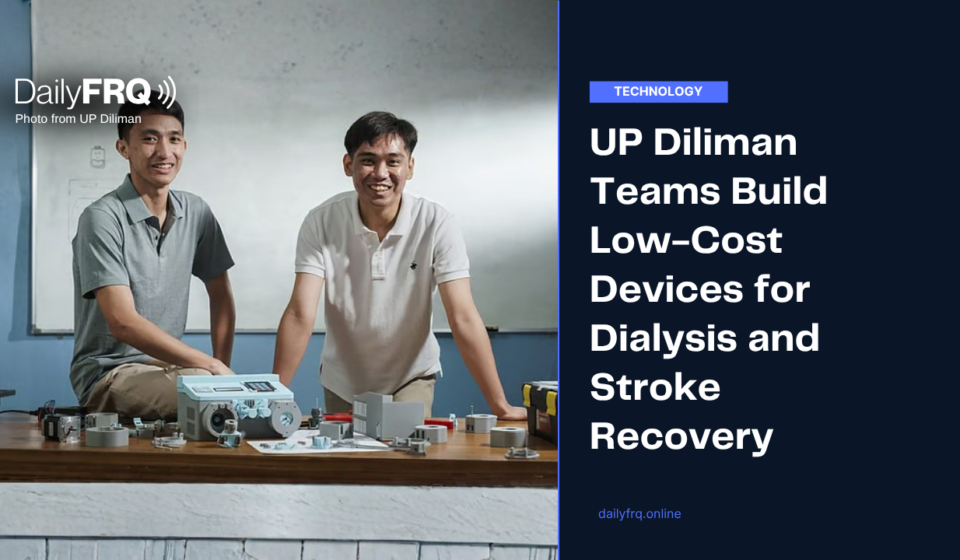
Two engineering teams at the University of the Philippines Diliman built low-cost devices for people living with kidney disease and stroke. Both earned national recognition at the 2026 James Dyson Award, and one has since reached the global Top 20.
Dialysis that fits inside a home routine
The number of Filipinos receiving dialysis rose 22% in 2024, to 64,845 from 53,296 the year before.
One option is peritoneal dialysis, which filters waste through the lining of the abdomen. It can be done at home, at work or while traveling. The routine is the hard part. Patients or caregivers manage repeated fluid exchanges, handle the tubing and record how much fluid goes in and out.
Automated machines called cyclers take over that work. The BiDaKidney team says commercial cyclers can cost more than $10,000.
Andrew Jacob Buensalido and Allyson Cabrestante built a semi-automated alternative. Peristaltic pumps move the dialysis fluid, load cells track how much is delivered and drained, and a microcontroller runs the sequence. The machine weighs about 2.5 kg and works with the standard peritoneal dialysis sets patients already use.
Their Dyson Award entry lists a target price of about $100. The team says it has not set a final selling price, because testing and certification add to the cost of any medical product.
Built from a sister’s stories
Buensalido’s older sister is a healthcare provider at a government hospital. She described what dialysis asks of patients and their families, and the pair went looking for the part of that routine engineering could ease. Over two semesters they built a working prototype and refined it through testing.
Peritoneal dialysis nurses and nephrologists at a tertiary government hospital gave the team feedback. Buensalido says the aim is to help patients “spend less of their lives managing dialysis and more of their time living it.”
BiDaKidney is still a prototype. It has not been through clinical trials, and the team says it needs clinical testing and regulatory approval before patients can use it. The national prize of P398,280 goes toward usability and safety features. The team also plans to explore battery operation, since power interruptions are a practical concern outside major urban centers.
A robotic elbow for therapy outside the clinic
OrthoFlex, built by Jabez Bote and Ada Koreen Bacay, targets stroke rehabilitation. It is a motor-driven elbow exoskeleton for repeated bending and straightening exercises, designed to complement therapy with a physical therapist.
Velcro cuffs hold the upper arm, forearm and wrist. The user pairs the device with a smartphone over Bluetooth and picks flexion or extension in a companion app. A stepper motor moves the elbow through a range of 0 to 135 degrees, and a limit built into the geared mechanism backs up the electronic controls.
Cost is central to the design. The prototype cost about P3,500 to build, and the team’s calculated retail price is around P10,000 (about $160). Their Dyson entry puts comparable products at P25,000 or more. The motor housing and cuffs attach with screws rather than adhesive, so worn pieces can be replaced one at a time.
The device is not yet a finished commercial product. The team plans to add a battery and a physical emergency stop button that works independently of the app. The app currently runs on Android, with iOS support planned.
Where the Dyson Award stands
BiDaKidney won the Philippine national prize in September, and OrthoFlex was named a national runner-up. On Oct. 14, the Global Top 20 was announced. BiDaKidney made the list, along with a concrete damage sensor called Sentinel. It is the first time the Philippines has placed two entries on the international shortlist. OrthoFlex was not among the Philippine entries named.
Twelve Dyson engineers chose the 20 finalists, judging functionality, design process, originality and commercial viability. Sir James Dyson picks the global winners, who will be announced on Nov. 4. Each receives P2,390,230.